









10Life Financial Limited
Enquiries: enquiries@10life.com
Hotline: (852) 3705 1599
Address: 16/F Greatmany Centre, 109-115 Queen’s Road East, Wan Chai, Hong Kong



What are the three high conditions referred to by “three highs”?
How common are the three highs in Hong Kong?
Can high blood pressure, high blood sugar and high cholesterol be reversed?
What should people with high blood pressure, high blood lipids and high blood sugar avoid eating? What dietary restrictions are there?
Can people with high blood pressure, high blood sugar and high cholesterol apply for medical insurance?
Does VHIS cover pre-existing high blood pressure, high cholesterol and high blood sugar?
Are there any medical insurance products in Hong Kong that people with high blood pressure, high cholesterol or high blood sugar may consider?
Take out cover early while you are in good health, as you will usually have more coverage options


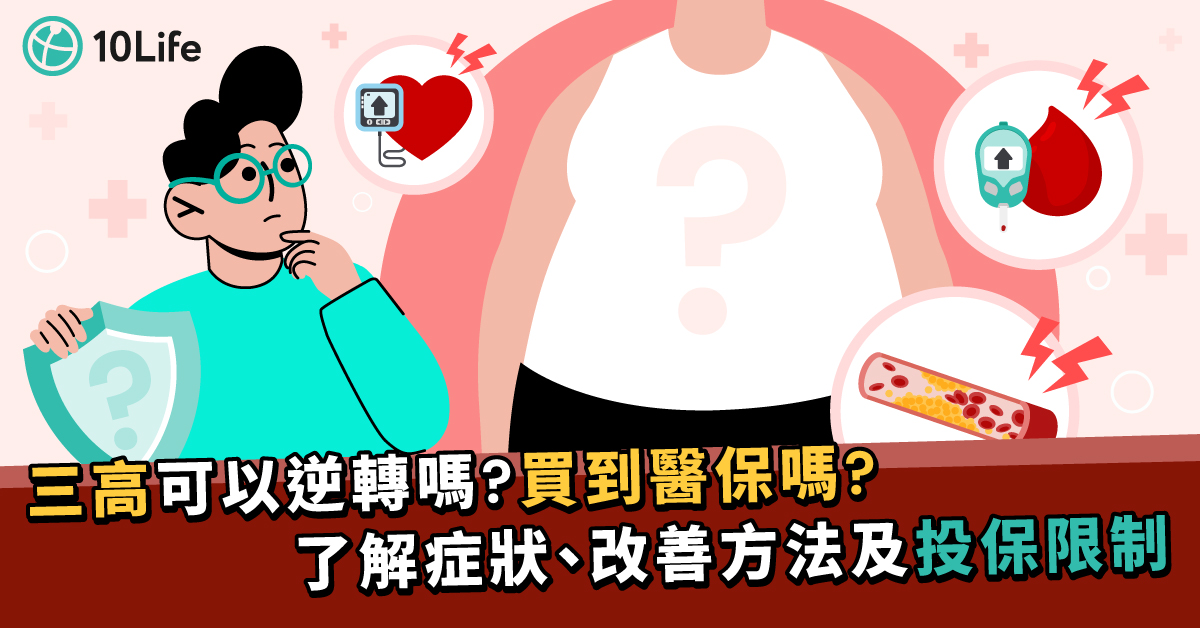
Hong Kong people live at a fast pace, spending long hours sitting with little exercise on weekdays, and often relying on takeaway meals. As a result, chronic health issues are becoming increasingly common. Among them, the “three highs” — high blood pressure, high blood sugar and high blood lipids — are often only discovered after a medical check-up, when many people first realise that their health has taken a turn for the worse.
In the early stages, the three highs may not necessarily affect daily life, but in the long run, the risks are certainly not to be overlooked. For insurers, elevated blood pressure, blood sugar or blood lipids are not merely numbers on a medical report, but key risk indicators during underwriting. So, can people with the three highs buy medical insurance?
In this article, 10Life explores the three highs issue with you, analysing the possible restrictions when applying for medical insurance, to help you understand your health risks and any gaps in your existing coverage.
What are the three high conditions referred to by “three highs”?
The three highs generally refer to high blood pressure, high blood sugar and high blood lipids. These three conditions do not necessarily occur at the same time, but if any one of them is not well controlled over the long term, it should not be taken lightly.
Tri-high categories | Common reference indicators |
| High blood pressure | Systolic pressure persistently ≥140 mmHg or diastolic pressure persistently ≥90 mmHg |
| High blood sugar / diabetes | Fasting blood glucose ≥7.0 mmol/L or HbA1c ≥6.5% |
| High blood lipids / high cholesterol | Total cholesterol ≥5.2 mmol/L may be used as a reference definition for hypercholesterolaemia |
The above indicators are for preliminary reference only. The actual diagnosis and treatment plan should still be based on the doctor’s assessment and laboratory report.
How common are the three highs in Hong Kong?
According to the Department of Health’s 2020–22 Population Health Survey, among Hong Kong residents aged 15 to 84, the prevalence of hypertension was 29.5%, diabetes 8.5%, and hypercholesterolaemia as high as 51.9%.
Health condition | Prevalence among Hong Kong residents aged 15 to 84 |
| Hypertension | 29.5% |
| Diabetes | 8.5% |
| Hypercholesterolaemia | 51.9% |
The “three highs” are easy to underestimate precisely because they may not have an immediate impact on daily life. Feeling well day to day does not mean there is no problem with your blood pressure, blood sugar or cholesterol; and a “red flag” on a medical check-up report may already be enough to affect an insurer’s underwriting decision.
Common Conditions | Common Symptoms / How It Is Detected | Potential Health Risks |
| High blood pressure | In most cases, there are no obvious symptoms. Some people may experience headaches, dizziness, tiredness and other symptoms. It is usually detected by measuring blood pressure. | If it remains uncontrolled for a long period, it may increase the risk of stroke, heart disease and kidney failure. |
| High blood sugar / diabetes | There may not be any obvious symptoms in the early stages, and it is often detected through a blood test. When blood sugar is high, symptoms may include frequent urination, thirst, weight loss or increased susceptibility to infections. | If poorly controlled, it may affect the blood vessels, nerves, kidneys, eyes and wound healing in the long term. |
| High blood lipids / high cholesterol | There are usually no obvious symptoms, and it is often only detected through a blood test. | If cholesterol remains high for a long time, fat may build up on the artery walls, increasing the risk of coronary heart disease and cardiovascular disease. |
Can high blood pressure, high blood sugar and high cholesterol be reversed?
High blood pressure, high blood sugar and high cholesterol can be improved and managed through lifestyle changes, diet control, exercise and medication. However, whether these conditions can be brought back to an ideal level still depends on an individual’s physical condition, the severity of the condition, lifestyle habits, and whether long-term medication is required.
Improving high blood pressure, high blood sugar and high cholesterol can be approached in the following ways:
What should people with high blood pressure, high blood lipids and high blood sugar avoid eating? What dietary restrictions are there?
People with high blood pressure, high blood sugar or high blood lipids do not necessarily need to avoid all their favourite foods, but they should steer clear of dietary habits that can easily cause blood pressure, blood sugar or blood lipid levels to become uncontrolled. In simple terms, it is best to start with a low-salt, low-sugar, low-fat, high-fibre diet.
Can people with high blood pressure, high blood sugar and high cholesterol apply for medical insurance?
Having high blood pressure, high blood sugar and high cholesterol does not mean you cannot buy medical insurance, but underwriting may be more stringent.
Many people think that as long as they have never been hospitalised or undergone surgery, they are still considered “healthy”. However, when insurers underwrite, they do not only look at whether the applicant has any major medical history in the past; they also assess the risk of future medical claims.
From an insurance perspective, medical insurance works by sharing healthcare costs across a risk pool. If an applicant has a higher health risk, such as existing high blood pressure, high blood sugar or high cholesterol, the insurer may consider that the likelihood of future claims is higher. As a result, it may balance the overall risk by charging a higher premium, adding specific exclusions, or imposing stricter underwriting conditions.
Therefore, people with the three highs are not necessarily unable to obtain medical insurance, but the underwriting outcome may differ from that of generally healthy individuals. What really matters is not only whether they can apply, but also whether the premium will increase after successful application, whether the cover will be complete, and whether illnesses or complications related to the three highs will be excluded.
Does VHIS cover pre-existing high blood pressure, high cholesterol and high blood sugar?
Many people assume that voluntary health insurance always covers pre-existing conditions, but in fact, it is first necessary to distinguish between “unknown pre-existing conditions” and “known pre-existing conditions before policy inception”.
If, before taking out the policy, you already knew that you had high blood pressure, diabetes or high cholesterol, these would generally not be regarded as “unknown pre-existing conditions”.
If you were in good health before taking out the policy, but later developed issues relating to the “three highs”, these would be treated as “unknown pre-existing conditions”. However, please note that, according to the official Voluntary Health Insurance Scheme information, all recognised products cover “unknown pre-existing conditions”. In terms of benefits, the policy provides 25% reimbursement in the second year after policy inception, 50% in the third year, and 100% from the fourth year onwards.
Therefore, it is generally advisable to take out medical insurance while you are still in good health, so that your protection will be more comprehensive.
Please note that insurance contracts are based on the principle of utmost good faith, and policyholders must disclose all relevant information truthfully when applying for cover.

Are there any medical insurance products in Hong Kong that people with high blood pressure, high cholesterol or high blood sugar may consider?
At present, there are not many medical protection products in the Hong Kong market that are specifically designed for people with the “three highs” and are still accepting new applications. Based on 10Life’s current compilation, Bowtie “StillCover” is one of the products in the market that more clearly targets people with the three highs, diabetes and other conditions who find it difficult to obtain traditional medical insurance. It is positioned as supplementary medical insurance, and mainly serves as a protection option for those who wish to fill the gaps in public healthcare services.
However, supplementary medical insurance does not mean comprehensive medical cover, and its scope of protection is also subject to certain limitations. Taking Bowtie “StillCover” as an example, both the Basic Plan and the Upgrade Plan guarantee renewal up to the age of 100, with a per-policy-year limit of HK$500,000 for specified items; inpatient and day-case surgery at public hospitals in Hong Kong are subject to a 20% co-insurance. As for cover at private hospitals in Hong Kong and hospitals in the Greater Bay Area, it is only available under the Upgrade Plan, limited to a specified medical network and designated treatment items, and prior written approval is required.
Therefore, before applying, people with the three highs should not focus solely on whether the insurer accepts applications. They should also carefully review the scope of cover, hospital restrictions, co-insurance, deductible, waiting period, exclusions and renewal terms, and rely on the official policy terms and underwriting outcome.
Take out cover early while you are in good health, as you will usually have more coverage options
People with high blood pressure, high blood lipids and high blood sugar are not necessarily unable to buy medical insurance, but once a diagnosis has been made before applying, the underwriting conditions are often stricter than for generally healthy individuals.
Therefore, for those who are still healthy and have no clear record of chronic illness, taking out medical insurance early will usually make it easier to obtain more comprehensive cover, and the premium may also be lower. Rather than waiting until abnormal indicators appear in a medical examination report before taking action, it is better to establish basic medical cover while in good health, and then review and top up any gaps in cover as needed in the future.
There are many medical insurance products on the market, so consumers may easily feel overwhelmed. Would you like someone to help explain the complicated policy terms and understand the scope of cover of different products? You are welcome to contact a 10Life insurance adviser via WhatsApp for enquiries.
This English version of this article has been generated by machine translation powered by AI. It is provided solely for reference purposes. In the event of any discrepancy or inconsistency between this translation and the original Chinese version, the Chinese version shall prevail.
身為10Life編輯團隊的一員,主力研究各種保險產品比較、拆解保單條款及索償細節,並與10Life持牌顧問緊密合作,致力將複雜術語轉化為易明分析,讓大眾更了解各種保險產品。
身為10Life編輯團隊的一員,主力研究各種保險產品比較、拆解保單條款及索償細節,並與10Life持牌顧問緊密合作,致力將複雜術語轉化為易明分析,讓大眾更了解各種保險產品。
10Life Product Comparison and 10Life Insurance Ratings are developed by 10Life Financial Limited, an authorised insurance broker company licensed with the Insurance Authority under License Number FB1526. 10Life Product Comparison and 10Life Insurance Ratings are developed for generic customer segments using mathematical calculations based on product information, facts and data, and are not influenced by any partnerships with or fees received from insurance companies. Any information on 10Life Platform ("10Life Information"), including but not limited to Product Comparison, Product Ratings, Blog Articles are intended for general education purpose and reference only. None of the 10Life Information is intended, nor should they be considered or relied upon, as regulated advice, insurance, financial, investment or professional advice, recommendation, approval, endorsement, invitation or solicitation in respect of any insurance, financial or investment products. 10Life Information does not take into account your individual needs. Reading 10Life Information should not be considered as conducting a suitability assessment, and is not sufficient to form the basis of any decisions to purchase any insurance products. You should rely on information authorised by insurance companies, carry out your own research and/or seek independent advice from licensed intermediaries before purchasing any insurance products or making any insurance decisions. While reasonable effort is used when collecting, validating and updating 10Life Information from various channels, none of 10Life Group and its subsidiaries, affiliates, agents, directors, officers and employees will be responsible for any liability, claim or loss arising from or associated with you using 10Life Information. No warranty, representation or guarantee is given by 10Life Group and its subsidiaries on the accuracy, completeness and timeliness of the information. If you have any questions on 10Life Product Comparison and 10Life Insurance Ratings, please email us at enquiries@10life.com




 Talk to 10Life on WeChat

