









10Life Financial Limited
Enquiries: enquiries@10life.com
Hotline: (852) 3705 1599
Address: 16/F Greatmany Centre, 109-115 Queen’s Road East, Wan Chai, Hong Kong



Is there a statutory retirement age in Hong Kong? What are the latest regulations?
What is the difference between retiring at 60 and 65?
Can I withdraw my MPF when I retire between the ages of 60 and 64?
Can you withdraw MPF if you are still working at the age of 65?
Retire at 60 or 65? What are the financial differences?
How can you arrange your retirement income apart from MPF?
Frequently Asked Questions about Retirement Age in Hong Kong


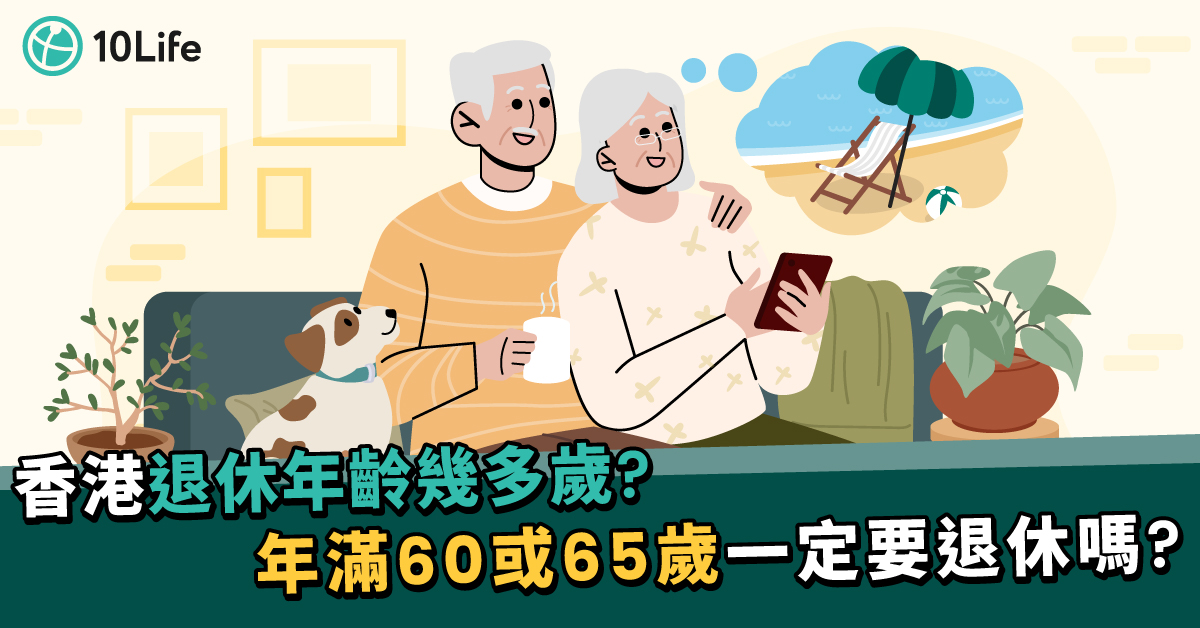
Retirement is a dream for many employees, but is the statutory retirement age in Hong Kong 60 or 65? Many people assume that they must retire upon reaching the age of 65, but in fact, Hong Kong does not have a uniform statutory retirement age. Retirement arrangements in private companies are generally determined by employment contracts and company policies, while civil servants and certain professions are subject to different retirement schemes.
As for why you often hear people referring to “retirement at 60” or “retirement at 65”, this is also related to the age at which the Mandatory Provident Fund (MPF) can be withdrawn. At what age can you withdraw your MPF? Are you entitled to long service payment if you retire at 65?
In this article, 10Life summarises Hong Kong’s retirement age, retirement arrangements for different employees, and the MPF and employment rights to be aware of when retiring.
Is there a statutory retirement age in Hong Kong? What are the latest regulations?
Hong Kong does not have a single statutory retirement age. The Employment Ordinance does not require all employees to retire at the age of 60 or 65. Arrangements in the private sector are determined by the employment contract and company policy.
However, civil servants and certain professions have separate retirement systems, so the retirement age may vary between employees.
Not necessarily. Some companies may stipulate that employees retire at 60 or 65, while others do not have a uniform retirement age.
If you wish to continue working after the retirement age specified by the company, you may discuss extending your employment period or re-employment arrangements with your employer. However, not all employers are obliged to allow employees to continue working.
Therefore, when approaching retirement age, in addition to understanding the MPF arrangements, you should first check your employment contract and employee handbook to confirm the company's retirement policy and related benefits.
Unlike private companies, Hong Kong civil servants have a specified normal retirement age, while arrangements for teachers depend on the type of school and the applicable employment system.
| Employee category | Retirement age or arrangement |
|---|---|
| Employees of private companies | Determined by the employment contract and company policy |
| Civilian civil servants joining on or after 1 June 2015 | Normal retirement age is 65 |
| Disciplined services officers joining on or after 1 June 2015 | Normal retirement age is 60 |
| Civil servants who joined earlier | Depends on the grade, date of joining and whether an extension of service has been opted for |
| Teachers in government schools | Subject to the applicable civil service retirement system; generally 65 for those joining on or after 1 June 2015 |
| Teachers in aided schools | Generally 60, with an extension of service permitted in special circumstances |
Under the Education Ordinance, teachers and principals of aided schools generally retire at 60. However, in special circumstances, schools may apply to the Education Bureau for an extension of service. If approved, service may be extended for up to five consecutive school years.
In addition to retirement age, retirement benefits also vary between professions. For example, eligible teachers in aided schools are required to contribute to the Provident Fund for Subsidised/Aided Schools, while the Government will also provide a grant based on the teachers' years of contribution. Therefore, before retirement, you should first understand your terms of employment and the relevant retirement benefits.
Sources: Civil Service Bureau, Government Press Release: Raising the Retirement Age, Education Bureau: Provident Fund for Subsidised/Aided Schools
No. Some public systems set different ages according to grade, but the difference arises from the grade rather than gender.
What is the difference between retiring at 60 and 65?
Although Hong Kong does not have a unified statutory retirement age, 60 and 65 are two important ages under the MPF system. The main differences are whether MPF can be withdrawn and whether the early retirement conditions must be met when applying.
Generally speaking, you may apply to withdraw your MPF after reaching the age of 65, even if you are still working. However, if you wish to withdraw it between the ages of 60 and 64 on the grounds of early retirement, you must meet the conditions specified by the MPFA.
| Comparison item | Aged 60 to 64 | Aged 65 or above |
|---|---|---|
| Is retirement compulsory? | No, depending on the employment contract and occupational scheme | No, depending on the employment contract and occupational scheme |
| Can MPF be withdrawn? | You must meet the conditions for early retirement or other statutory withdrawal conditions | You may apply for withdrawal in accordance with the applicable requirements |
| Can you continue working when withdrawing MPF? | When applying on the grounds of early retirement, you must have ceased all employment and self-employment | You may continue working |
| Are MPF contributions still required? | You must continue making contributions if you meet the contribution requirements | Generally, no further mandatory contributions are required |
Can I withdraw my MPF when I retire between the ages of 60 and 64?
Yes, but if you apply on the grounds of early retirement, you must be at least 60 years old, have ceased all employment and self-employment, and make a statutory declaration confirming that you have no intention of working again.
In other words, simply leaving full-time employment at the age of 60 does not mean that you can immediately withdraw your MPF. For example, if you have left full-time employment but continue to work part-time, you do not meet the conditions for withdrawing MPF on the grounds of early retirement.
If you retire before the age of 60, you cannot withdraw your MPF early solely on the grounds of retirement either; unless you meet other statutory withdrawal conditions, you will generally have to wait until you meet the withdrawal age and eligibility requirements before applying.
Can you withdraw MPF if you are still working at the age of 65?
Yes. Once they reach the age of 65, individuals may apply to withdraw their MPF even if they are still working full-time or part-time; they do not need to leave their job first.
Retirees may choose to withdraw their MPF as a lump sum, make withdrawals by instalments, or temporarily retain it in the scheme for continued investment, depending on their needs. However, any balance that has not been withdrawn will remain subject to market fluctuations, and making withdrawals by instalments does not guarantee a monthly income.
Retire at 60 or 65? What are the financial differences?
Would you like to have more time to travel and pursue your interests after retirement, but are unsure whether you can afford it financially? You need sufficient funds. How much money do you need to prepare for retirement? How can you carry out retirement planning?
If you retire at 60, you may lose five years of salary income, employer MPF contributions and investment growth, while having to cover an additional five years of retirement living expenses. By contrast, if you work until 65, you may have the opportunity to accumulate an additional five years of income and retirement assets.
For example, assuming your monthly living expenses after retirement are HK$25,000, retiring five years early would require approximately HK$1.5 million in additional living expenses alone. This does not include the impact of inflation, medical expenses, or the loss of five years of income and investment growth.
Therefore, before deciding at what age to retire, in addition to considering your personal preferences, you should also calculate whether your existing MPF, savings and other income will be sufficient to cover your future living expenses.
Note: The above estimate of HK$1.5 million is based on a simple calculation of HK$25,000 per month × 12 months × 5 years, excluding inflation, investment returns and other income.
How can you arrange your retirement income apart from MPF?
After retirement, you no longer need to work from nine to six, giving you more time to pursue your interests and enjoy life. However, without a fixed monthly salary, how can you cover your daily expenses? MPF may not be sufficient to support your entire retirement, so in addition to MPF, you can consider different retirement financial planning tools early, according to your personal needs.
If retirement is still some way off, you can compare the returns and breakeven periods of savings insurance to accumulate funds for retirement. If you hope to prepare for retirement income early while enjoying tax benefits, you may consider tax-deductible annuities, paying attention to the premium payment period, age at which benefits begin and policy term. If you are approaching retirement and need a more stable cash flow, you can learn more about the guaranteed income and payment arrangements of immediate annuities.
However, different tools involve varying levels of risk and liquidity. For example, the non-guaranteed returns of savings insurance may not materialise, and you may not be able to recover all premiums paid if you surrender the policy early. For annuities, you should also pay attention to the payment arrangements and restrictions on early withdrawal.
Through actuarial ratings and product comparisons, 10Life makes it easier for you to understand the returns and relevant terms of different savings insurance plans. You can use 10Life's savings insurance comparison page or tax-deductible annuity comparison page to compare products side by side and find a solution that fits your retirement plans.
If you would like to learn more about retirement financial planning strategies, feel free to contact 10Life's insurance advisers via Whatsapp.
Frequently Asked Questions about Retirement Age in Hong Kong
Hong Kong does not have a uniform statutory retirement age based on gender. Retirement arrangements for employees of private companies generally depend on their employment contracts and company policies; certain public-sector positions have specified retirement ages based on the grade and date of appointment.
Generally, no. Even if you have stopped working at the age of 55, you cannot withdraw your MPF immediately solely on the grounds of retirement. Unless you meet other statutory conditions for early withdrawal, you will generally need to be at least 60 years old and meet the conditions for early retirement, or wait until the age of 65 before applying.
You may resume working, but you should take note of the conditions for withdrawing MPF. If you intend to withdraw MPF on the grounds of early retirement, you must have ceased all employment and self-employment at the time of application and truthfully declare that you do not intend to work again. If you resume working after a successful withdrawal due to a change in your personal circumstances, this is not prohibited by law, but you must still comply with the applicable MPF contribution requirements.
Generally, no. Mandatory MPF contributions mainly apply to eligible employees and self-employed persons aged 18 to under 65. After reaching the age of 65, employers and employees generally no longer need to make mandatory contributions, even if they continue working.
Hong Kong currently does not have a uniform statutory retirement age applicable to all employees. Therefore, there is no uniform policy to delay the retirement age applicable to all workers. For civil servants and other occupations with a specified retirement age, you should take note of the latest arrangements of your department or organisation.
This English version of this article has been generated by machine translation powered by AI. It is provided solely for reference purposes. In the event of any discrepancy or inconsistency between this translation and the original Chinese version, the Chinese version shall prevail.
10+ years in editing & copywriting. I love solving puzzles — now my goal is making insurance jargon simple. Let's decode policies and learn together.
10+ years in editing & copywriting. I love solving puzzles — now my goal is making insurance jargon simple. Let's decode policies and learn together.
10Life Product Comparison and 10Life Insurance Ratings are developed by 10Life Financial Limited, an authorised insurance broker company licensed with the Insurance Authority under License Number FB1526. 10Life Product Comparison and 10Life Insurance Ratings are developed for generic customer segments using mathematical calculations based on product information, facts and data, and are not influenced by any partnerships with or fees received from insurance companies. Any information on 10Life Platform ("10Life Information"), including but not limited to Product Comparison, Product Ratings, Blog Articles are intended for general education purpose and reference only. None of the 10Life Information is intended, nor should they be considered or relied upon, as regulated advice, insurance, financial, investment or professional advice, recommendation, approval, endorsement, invitation or solicitation in respect of any insurance, financial or investment products. 10Life Information does not take into account your individual needs. Reading 10Life Information should not be considered as conducting a suitability assessment, and is not sufficient to form the basis of any decisions to purchase any insurance products. You should rely on information authorised by insurance companies, carry out your own research and/or seek independent advice from licensed intermediaries before purchasing any insurance products or making any insurance decisions. While reasonable effort is used when collecting, validating and updating 10Life Information from various channels, none of 10Life Group and its subsidiaries, affiliates, agents, directors, officers and employees will be responsible for any liability, claim or loss arising from or associated with you using 10Life Information. No warranty, representation or guarantee is given by 10Life Group and its subsidiaries on the accuracy, completeness and timeliness of the information. If you have any questions on 10Life Product Comparison and 10Life Insurance Ratings, please email us at enquiries@10life.com




 Talk to 10Life on WeChat
