









10Life Financial Limited
Enquiries: enquiries@10life.com
Hotline: (852) 3705 1599
Address: 16/F Greatmany Centre, 109-115 Queen’s Road East, Wan Chai, Hong Kong



What is the difference between a tax deduction and a tax allowance?
Tax-saving essentials: the three tax deduction products
Other popular tax-deductible items
Frequently Asked Questions


Every tax season, many salaried employees are most concerned about one question: “What can I claim tax deductions for? How can I save the most?”
Under Hong Kong’s tax regime, there are a number of tax deductions, including the recent popular “three tax-saving essentials”, domestic rent deduction, home loan interest, and more. As long as you meet the eligibility requirements, you can reduce your taxable income and, in turn, lower the final amount of tax payable.
However, many people easily get confused about the conditions, caps and application methods for each deduction, for example:
This article from 10Life sets out the 10 most popular tax deduction methods for the 2025/26 year, together with the eligibility requirements and common misconceptions, so you can understand everything at a glance.
| Item | Maximum deduction |
| MPF tax-deductible voluntary contributions (TVC) + Qualifying Deferred Annuity (QDAP) | HK$60,000 |
| Voluntary Health Insurance Scheme (VHIS) | HK$8,000 per person |
| Mandatory MPF contributions | HK$18,000 |
| Personal education expenses | HK$100,000 |
| Rent deduction | HK$100,000 |
| Home loan interest | HK$100,000 |
| Elderly residential care | HK$100,000 |
| Charitable donations | 35% of income |
| Assisted reproductive services | HK$100,000 |
What is the difference between a tax deduction and a tax allowance?
Many people think that “tax deductions” and “allowances” are the same thing, but their calculation methods are actually different.
Calculated based on actual expenditure, for example:
Proof of actual expenditure is required.
Determined by personal or family circumstances, and no proof of actual expenditure is required. For example:
Tax deductions and allowances can be used together to reduce assessable income.
Tax-saving essentials: the three tax deduction products
The so-called “big three tax-deductible products” generally refer to:
In recent years, these three types of products have become popular choices for many people before filing their tax returns, as they help ease the current tax burden while also providing retirement and medical protection.
Tax-deductible products’ deduction limits:
It is particularly important to note that TVC and QDAP do not each have a separate tax deduction limit; instead, they share the same HK$60,000 tax-deductible cap.
TVC stands for Tax Deductible Voluntary Contributions. It is an MPF tax concession introduced by the Government to encourage the public to save more for retirement.
In addition to the mandatory monthly MPF contributions, salaried employees may also open a separate TVC account and make additional contributions, thereby increasing retirement savings while enjoying tax benefits.
The contribution method is relatively flexible, with the option of:
The contribution amount does not need to be linked to income and can be adjusted at any time according to one’s financial circumstances.
Some MPF schemes may set minimum or maximum contribution requirements. However, please note that TVC funds are generally required to remain until retirement at age 65, or can only be withdrawn under circumstances specified by law. As such, they are more suitable for retirement savings rather than short-term investment or cash flow needs.
TVC and Qualifying Deferred Annuity Policy (QDAP) share a combined annual tax deduction limit of HK$60,000
For example:
Please note that the tax deduction for Tax Deductible Voluntary Contributions (TVC) is calculated by tax year. Contributions are generally required to be made by 31 March each year; otherwise, they will usually be carried forward to the next tax year. In addition, TVC is not granted tax deduction automatically. Taxpayers must declare the relevant contribution details in their tax return; otherwise, the Inland Revenue Department may not process it automatically.
| Item | Employee Voluntary Contributions | Special Voluntary Contributions | TVC (Tax Deductible Voluntary Contributions) |
| Scheme selection | Selected by the employer | Chosen by the member | Chosen by the member |
| Contribution method | Deducted from salary through the employer | Contributed directly to the scheme | Contributed directly to the scheme |
| Tax deductible | Not applicable | Not applicable | Tax deductible (up to HK$60,000) |
| Withdrawal conditions | Generally upon contract termination | According to personal needs | Same as mandatory contributions (usually at age 65) |
A QDAP (Qualifying Deferred Annuity Policy, 合資格延期年金保單) is a deferred annuity product certified by the Insurance Authority and eligible for tax deductions. Many people use it for retirement planning, hoping to have a more stable income after retirement while also saving part of their tax during the contribution period.
The usual arrangement is to pay first and receive the annuity later: the policyholder pays premiums over a specified period, and once the accumulation period ends, annuity income starts to be received periodically.
In general, to qualify as an approved QDAP, a product must usually meet the following basic requirements:
If the taxpayer or a cohabiting spouse is the policyholder and is responsible for paying the premiums, they may claim the relevant tax deduction.
The combined tax deduction limit for each taxpayer for QDAP + TVC is HK$60,000; if both spouses are liable to tax, they may allocate the deduction between themselves, with a maximum combined claim of HK$120,000.
Based on the highest marginal tax rate of 17%, each person can save up to HK$10,200 in tax per year.
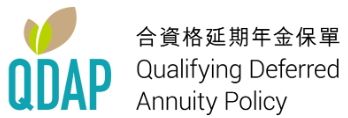
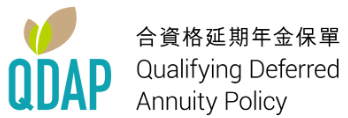
Many people think that any annuity product is tax-deductible, but that is not necessarily the case. Only QDAPs certified by the Insurance Authority are eligible. Immediate annuities or uncertified products generally do not enjoy the relevant tax benefits. To quickly determine whether a product qualifies, you may check whether the policy documents or product information bear the QDAP certification mark below before purchasing.
The Voluntary Health Insurance Scheme (VHIS) is a government-recognised healthcare protection scheme designed to encourage members of the public to purchase eligible policies, strengthen personal healthcare protection, and enjoy tax benefits at the same time.
The products are mainly divided into two categories: Standard Plans and Flexi Plans. Each insured person may claim up to HK$8,000 in tax deduction per year, and applications can also be made for multiple specified relatives (such as a spouse, children and parents), with no limit on the number of insured persons.
For example, for a family of five, if each person’s premium exceeds HK$8,000, the maximum deduction can reach HK$40,000. Calculated at the highest tax rate of 17%, this could save up to HK$6,800 in tax.
However, please note that the actual tax savings are not a direct HK$8,000 deduction; instead, they are calculated based on “actual premium × individual tax rate”.
For example, if the premium is HK$5,000 and the applicable tax rate is 17%, the actual tax savings would be HK$850. Even if the premium exceeds HK$8,000, the deduction remains capped at HK$8,000 per insured person.
Other popular tax-deductible items
In addition to tax-deductible voluntary contributions, mandatory contributions under the Mandatory Provident Fund can also be claimed for tax deduction, but the two are fundamentally different and should not be confused. Under the Mandatory Provident Fund Schemes Ordinance, employees and employers must each contribute 5% of monthly salary, subject to a monthly cap of HK$1,500. The maximum deduction for this mandatory contribution is HK$18,000 per tax year, and this is calculated separately from the HK$60,000 cap for tax-deductible voluntary contributions and eligible deferred annuity premiums. The two do not affect each other.
Personal Education Expenses
From the 2017/18 tax year onwards, the maximum deduction for personal education expenses increased from HK$80,000 to HK$100,000. Taxpayers should claim the deduction for actual personal education expenses in the tax year in which payment is made.
Eligible items:
However, please note that the course of study must meet the following specific conditions:
If you need to arrange for your parents, grandparents or great-grandparents to live in a residential care home, nursing home or similar institution, the related residential care expenses may be claimed for tax deduction, easing the family’s financial burden.
Maximum deductible amount per year: HK$100,000
When applying, the following conditions generally must be met:
Please note: this cannot be claimed at the same time as the dependant parent allowance. Many people think both can be claimed together, but in fact only one of the two options may be chosen for the same elderly person in the same tax year, and you need to decide how to make the claim yourself.
In addition, each elderly person may only be claimed by one taxpayer each year. If more than one child is eligible, coordination is required first.
Property owners can reduce their tax burden through the home loan interest deduction.
Currently:
Each taxpayer may claim up to 20 tax years in total, not necessarily consecutively.
Basic requirements:
The following are generally not eligible:
Rent is also tax-deductible. The cap is HK$100,000. If the monthly rent is around HK$8,333, the deduction limit will generally be fully used up.
Basic requirements:
The following persons are generally not eligible:
Tax deduction for charitable donations|Not all donations are deductible
Charitable donations are also tax-deductible, but not every “donation” qualifies.
Application requirements:
The recipient must be a recognised charitable institution, and it is advisable to keep official receipts.
The following are generally not eligible:
The government has introduced a new tax deduction arrangement for “assisted reproductive services expenses” from the 2024/25 tax year onwards, with an annual maximum deduction of HK$100,000. Please note that for married couples, the deduction is not HK$100,000 per person; instead, the maximum is HK$100,000 in total for both spouses.
Applications generally must meet the following basic requirements:
In addition, if the relevant expenses have already been reimbursed by insurance or compensated by other benefits, only the unreimbursed portion may be claimed.
Frequently Asked Questions
In general, the Inland Revenue Department will send out tax bills progressively from October each year, giving taxpayers sufficient time to arrange payment of tax. If you have activated the eTax Bill service, you will need to log in to your “eTAX” account to view the latest assessment notice. More on the tax bill process
If you have submitted your tax return but have yet to receive your tax bill, you may first check by the following methods:
Also note that if your income for the year of assessment does not reach the tax payment threshold, the Inland Revenue Department may not issue a tax bill. Learn more about tax bill information
Different tax-deductible items, such as VHIS, QDAP, TVC, rent and personal education expenses, must be filled in the designated sections of the tax return. Read the tax return guide
By e-filing through “eTAX”, in addition to a more convenient process, you will usually also automatically receive an extra one-month grace period for filing your tax return.
For those who are often racing against the deadline, submitting electronically may be worth considering.
Many people consider VHIS, QDAP and TVC at the same time, but their tax deduction methods and limits differ. For example, TVC and QDAP share a tax deduction limit of HK$60,000, while VHIS is calculated per insured person. Learn more about the tax-saving guide for the three tax-deductible options
Yes. If you discover that information was omitted after submitting your tax return, you may apply to the Inland Revenue Department for amendments or submit the missing information. However, it is advisable to keep the relevant receipts, premium records and supporting documents for future verification.
This English version of this article has been generated by machine translation powered by AI. It is provided solely for reference purposes. In the event of any discrepancy or inconsistency between this translation and the original Chinese version, the Chinese version shall prevail.
10+ years in editing & copywriting. I love solving puzzles — now my goal is making insurance jargon simple. Let's decode policies and learn together.
10+ years in editing & copywriting. I love solving puzzles — now my goal is making insurance jargon simple. Let's decode policies and learn together.
10Life Product Comparison and 10Life Insurance Ratings are developed by 10Life Financial Limited, an authorised insurance broker company licensed with the Insurance Authority under License Number FB1526. 10Life Product Comparison and 10Life Insurance Ratings are developed for generic customer segments using mathematical calculations based on product information, facts and data, and are not influenced by any partnerships with or fees received from insurance companies. Any information on 10Life Platform ("10Life Information"), including but not limited to Product Comparison, Product Ratings, Blog Articles are intended for general education purpose and reference only. None of the 10Life Information is intended, nor should they be considered or relied upon, as regulated advice, insurance, financial, investment or professional advice, recommendation, approval, endorsement, invitation or solicitation in respect of any insurance, financial or investment products. 10Life Information does not take into account your individual needs. Reading 10Life Information should not be considered as conducting a suitability assessment, and is not sufficient to form the basis of any decisions to purchase any insurance products. You should rely on information authorised by insurance companies, carry out your own research and/or seek independent advice from licensed intermediaries before purchasing any insurance products or making any insurance decisions. While reasonable effort is used when collecting, validating and updating 10Life Information from various channels, none of 10Life Group and its subsidiaries, affiliates, agents, directors, officers and employees will be responsible for any liability, claim or loss arising from or associated with you using 10Life Information. No warranty, representation or guarantee is given by 10Life Group and its subsidiaries on the accuracy, completeness and timeliness of the information. If you have any questions on 10Life Product Comparison and 10Life Insurance Ratings, please email us at enquiries@10life.com



 Talk to 10Life on WeChat
