









10Life Financial Limited
Enquiries: enquiries@10life.com
Hotline: (852) 3705 1599
Address: 16/F Greatmany Centre, 109-115 Queen’s Road East, Wan Chai, Hong Kong





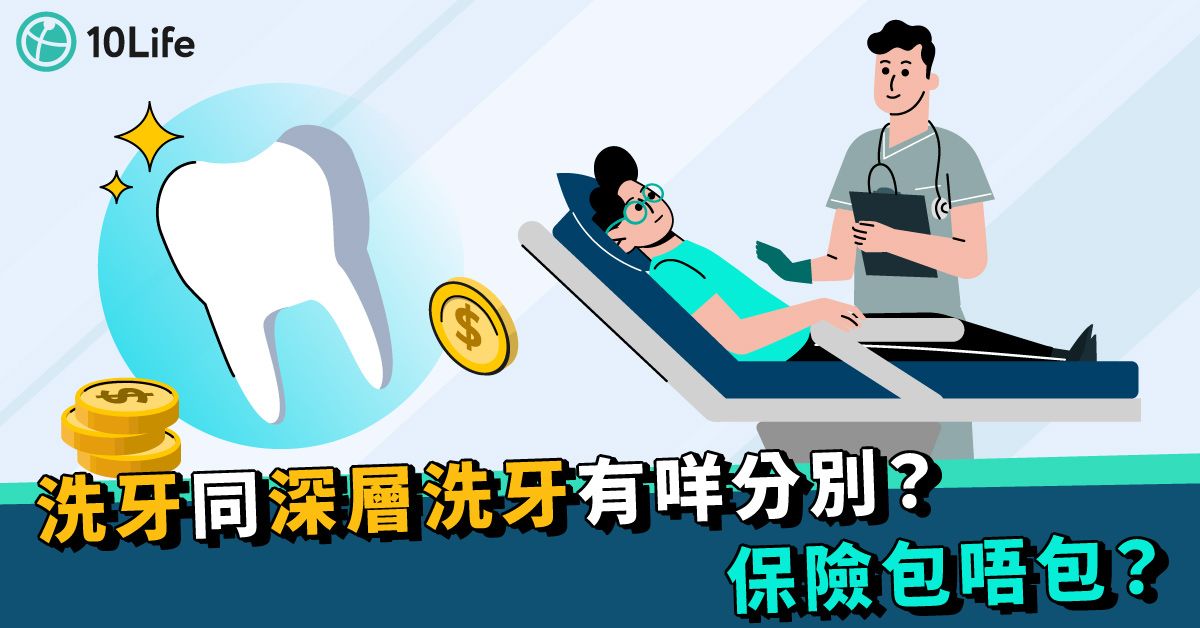
People today are highly conscious of protecting their teeth. After all, only healthy teeth allow you to enjoy all the delicacies the world has to offer, while dental cleaning is a care procedure that should be carried out regularly. But how often should you have your teeth cleaned? What is a reasonable price? Do you need deep dental cleaning? And which insurance policies cover dental cleaning expenses? The following eight key considerations answer all these questions at once.
1. What is the purpose of teeth cleaning?
Teeth cleaning removes plaque, tartar and stains adhering to the surface of the teeth, restoring them to a clean and smooth condition. This eliminates the bacteria that cause periodontal disease and reduces the risk of developing it. In the most severe cases, periodontal disease can cause serious damage to the periodontal tissues, including the gums and alveolar bone, resulting in alveolar bone loss. Consequently, the teeth lose support, become loose and shift position, and may eventually fall out.
2. Why do teeth stains occur?
Many people have their teeth cleaned not only to prevent gum disease, but also to remove dental stains. The main causes of dental stains include frequent smoking or consuming drinks with strong colourants, such as tea or coffee. The colourants can accumulate on the surface of the teeth, forming black or brown stains. In addition, if the teeth are not brushed thoroughly enough, dental plaque can accumulate over time and absorb colourants from food, also causing dental stains. To prevent dental stains from forming, the Department of Health recommends:
3. What is the dental cleaning procedure?
According to information from the Department of Health’s “Tooth Club”, dentists use dental instruments or ultrasonic scalers to remove firmly attached tartar. This includes polishing the tooth surfaces with dental-grade pumice powder, or using air to mix fine soda powder (sodium bicarbonate) with water and spray the mixture onto the tooth surfaces at high speed through a nozzle, removing stains and keeping the tooth surfaces smooth. Patients with periodontal disease may experience mild oral discomfort and bleeding gums for a few days after scaling. As long as they continue to maintain good oral hygiene, the oral discomfort and gum bleeding will gradually subside, and the gums will return to a healthy condition.
4. Can teeth cleaning whiten teeth?
No. According to the Department of Health’s Tooth Club, teeth whitening is a separate procedure in which a dentist uses chemical agents to lighten the pigmentation or stains within the enamel or dentine.
5. How often should I have my teeth cleaned?
General dentists recommend booking a scaling appointment every 6 months to 1 year. If you have more severe periodontal disease, you will need to undergo scaling and examinations more frequently each year than other people.
6. What is the difference between a dental cleaning and deep cleaning?
To understand why deep dental cleaning is necessary, it is first important to understand the depth of periodontal pockets formed when the periodontal tissues are damaged. A depth of 4 millimetres or more is defined as a periodontal pocket, which may indicate gum disease, and deep dental cleaning should be carried out according to the dentist’s instructions. Deep dental cleaning usually requires a local anaesthetic. The dentist may use a laser to remove plaque and tartar, or traditional dental instruments, including curettes and an ultrasonic scaler, to smooth the surface of the gums so that they can reattach to the teeth and eliminate the periodontal pockets. The price or cost of deep dental cleaning is usually considerably higher than that of a routine dental cleaning, depending on the overall complexity of the treatment.
7. How do the prices of routine dental cleaning compare?
There is often controversy surrounding the charges for dental scaling, for example, some people have relatively clean teeth and therefore the dentist spends less time performing the scaling, but still charges the standard listed price, leading to dissatisfaction among some consumers. Another issue is that some people misunderstand the difference between dental scaling and deep cleaning. As mentioned above, deep cleaning is required when a patient has serious periodontal disease, and the dentist needs to use more complex procedures and techniques for the treatment. Therefore, the charges are usually much higher than those for ordinary dental scaling. 10Life collected the dental scaling charges of some private hospitals and clinics through their websites and customer service channels for reference. Some providers require payment of an initial consultation fee before scaling can be performed; some determine the charges according to the level of cleanliness of the teeth; while one hospital clearly states the time required for the scaling procedure for everyone’s reference.
| Private hospital or clinic | Charges (HK$) |
| HKSH Dental Centre | $2,500 (1 hour) (Initial consultation fee of up to $2,000) |
| St. Paul’s Hospital | $980 (Initial consultation fee of $550) |
| Union Hospital Specialist Clinic (Tsim Sha Tsui) | $1,000 to $1,200 (Additional initial consultation fee of $300 to $500) |
| Tsuen Wan Adventist Hospital | $650 to $900 (Depending on the level of cleanliness of the teeth) |
| General dental clinic | Generally $500 to $800 |
8. Does insurance cover dental cleaning? Which insurance plans mainly cover dental care?
Most medical insurance policies exclude dental-related treatments, unless they are required as a result of an accident or the policyholder has purchased additional dental cover. Taking the VHIS Standard Plan as an example, the Food and Health Bureau stipulates that it only covers emergency treatment and surgery received for dental treatment during hospitalisation when caused by an accident. It does not provide reimbursement for dental cleaning expenses, while cosmetic procedures such as orthodontics and teeth whitening are naturally excluded. However, other inpatient and outpatient dental cover may be provided through supplementary benefits under Flexi Plans, although additional premiums are payable. Many group medical insurance policies in the market also “cover dental cleaning”, but they will specify expense or frequency limits. In addition, some dental insurance or healthcare plans offer reimbursement for dental cleaning, but impose monetary or frequency limits, and some also include a deductible. For details, please contact 10Life insurance advisers.
Further reading:
【Wisdom teeth cost 2025】What should you do if they become inflamed and your gums swell? Is extraction necessary?
【Dental insurance】Dental care in Hong Kong or Shenzhen? Both have their advantages (with a comparison of dental insurance products)
Note: This article was last updated on 10 March 2025.
This English version of this article has been generated by machine translation powered by AI. It is provided solely for reference purposes. In the event of any discrepancy or inconsistency between this translation and the original Chinese version, the Chinese version shall prevail.

Our team of professional content researchers focussing on insurance
Our team of professional content researchers focussing on insurance
10Life Product Comparison and 10Life Insurance Ratings are developed by 10Life Financial Limited, an authorised insurance broker company licensed with the Insurance Authority under License Number FB1526. 10Life Product Comparison and 10Life Insurance Ratings are developed for generic customer segments using mathematical calculations based on product information, facts and data, and are not influenced by any partnerships with or fees received from insurance companies. Any information on 10Life Platform ("10Life Information"), including but not limited to Product Comparison, Product Ratings, Blog Articles are intended for general education purpose and reference only. None of the 10Life Information is intended, nor should they be considered or relied upon, as regulated advice, insurance, financial, investment or professional advice, recommendation, approval, endorsement, invitation or solicitation in respect of any insurance, financial or investment products. 10Life Information does not take into account your individual needs. Reading 10Life Information should not be considered as conducting a suitability assessment, and is not sufficient to form the basis of any decisions to purchase any insurance products. You should rely on information authorised by insurance companies, carry out your own research and/or seek independent advice from licensed intermediaries before purchasing any insurance products or making any insurance decisions. While reasonable effort is used when collecting, validating and updating 10Life Information from various channels, none of 10Life Group and its subsidiaries, affiliates, agents, directors, officers and employees will be responsible for any liability, claim or loss arising from or associated with you using 10Life Information. No warranty, representation or guarantee is given by 10Life Group and its subsidiaries on the accuracy, completeness and timeliness of the information. If you have any questions on 10Life Product Comparison and 10Life Insurance Ratings, please email us at enquiries@10life.com




 Talk to 10Life on WeChat
