false
Category
Author
Trending

Table of Content

Search for Articles
Trending Keywords
Category
Author
Search
Category
Author
Search
Travel and Overseas Study
Editor's Pick

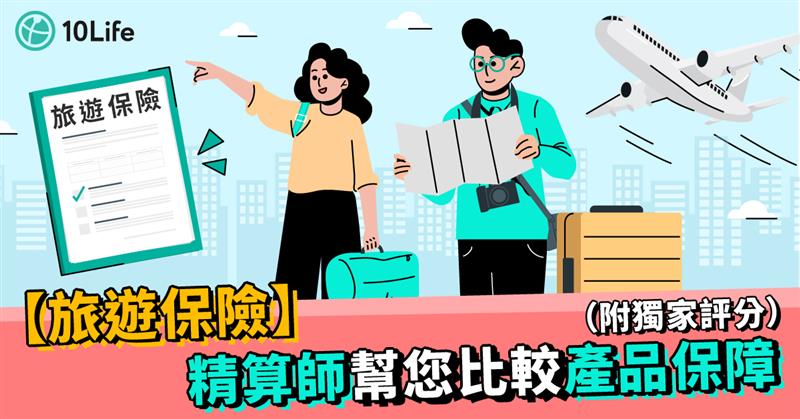
Which travel insurance is best? Experts explain 10 key details to check before choosing.

2026-03-18 5min read

Many Hong Kong people love to travel, and destinations such as Japan, South Korea, Thailand, Taiwan and Singapore have long been popular choices among Hong Kong travellers. Travel insurance, like booking flights and hotels, is one of the items many people will always prepare before going on holiday or on a business trip. However, with so many travel insurance products available at different prices, which one is the best? Information on travel insurance recommendations varies widely, and consumers may find it difficult to know where to begin when comparing them. Therefore, 10Life actuaries compared more than 50 single-trip travel insurance products, and also compared over 30 annual travel insurance products. This article selects a range of single-trip travel insurance products for a detailed comparison, to make it easier for readers to choose. 

Table 1: Comparison of travel insurance product premiums and coverage ratings (HKD)

Assuming the insured person is an adult, for a 4-day trip to Japan

ProductPremiumOverall scoreMedical and emergency assistance scoreTrip disruption scorePersonal belongings scorePersonal accident score
MSIG
iTravel Go(單次旅程)
計劃 A

$164
$327
Enjoy 50% off selected plans by applying online via 10Life
→Insure now←
<Covers trip cancellation for any reason and flight overbooking>¹

9.5

9.1

9.6

9.6

10.0

Blue Cross 藍十字
旅遊寶 - 環球 
藍鑽石計劃

$167
$257
Enjoy 35% off selected plans by applying online via 10Life
→Insure now←

8.9

8.5

9.7

8.4

8.8

BOC 中銀 
環宇遨翔旅遊保障計劃 
鑽石計劃(附加升級保障)
$266
$380
Enjoy 30% off selected plans by applying online via 10Life
→Insure now←
8.88.49.38.210.0
Blue Cross 藍十字 
智在遊
尊尚計劃
$285
→Insure now←
8.77.99.58.310.0
Generali 忠意保險
忠意旅遊保
尊貴計劃
$192
$319
Enjoy 40% off selected plans by applying online via 10Life
→Insure now←
8.68.97.49.010.0
Allianz安聯 
單次旅遊保險-
金計劃
$133
$222
40% off promo code:
AZSPECIAL40
→Insure now←
8.59.08.39.05.9
蘇黎世 Zurich 
「 易起行+」旅遊保險計劃 
優越計劃
$265
$353
25% off promo code: 10LIFETRAVEL25
→Insure now←
8.58.58.97.610.0
Starr 
「卓悅遊」旅遊保險 
尊貴計劃
$143
$230
Enjoy 40% off selected plans by applying online via 10Life
→Insure now←

8.4

8.3

8.5

8.4

8.6

AXA 安盛
「卓越」豐盛優遊樂 - 至尊計劃
$232
$290
Enjoy 20% off selected plans by applying online via 10Life
→Insure now←
8.48.09.47.010.0
BOC 中銀 
環宇遨翔旅遊保障計劃 
鑽石計劃
$243
$304
Enjoy 20% off when applying online via the insurer’s website through 10Life
→Insure now←
8.18.48.86.110.0
Dah Sing Insurance 
大新保險 
「智優遊」旅遊保障計劃
鑽石計劃
$191
$255
Enjoy 25% off when applying via 10Life to the insurer’s website
→Insure now←
7.97.89.06.38.8
QBE 昆士蘭保險 
旅遊保險單次旅遊 
金計劃
$149
$212
Enjoy 30% off selected plans by applying online via 10Life
→Insure now←
7.88.08.26.310.0

Note:     
Assuming the insured person is an adult, for a 5-day trip to Japan.     
Selected from travel insurance products with more comprehensive overall cover on the market, and ranked by 10Life overall score (high to low)  
Last updated: 18 June 2026 

¹Only applicable to PlanA, and must be purchased within seven days from the date the insured person first pays for or books the trip
²Up to HK$25,000, and only applicable to the First Class Plan. The policy must be purchased on or before 7 days after the date on which the insured person pays the first instalment or deposit for the trip, and the relevant cancellation or amendment must be made before the original departure time. Otherwise, claims under this section will not be accepted. Please refer to the policy terms, conditions and exclusions for details.

There is a wide gap in the maximum medical expense coverage for travel insurance; 7 products have an overall rating of 8.5 or above

This travel insurance analysis is written from the traveller’s perspective, considering what travellers worry about most when they are away from home. If you fall ill or are injured, can you receive proper care immediately? If your trip is cancelled at short notice, can you get back the money you have prepaid for flights and hotels? Even in the event of a serious accident, can your family feel reassured? Based on these real and common concerns, 10Life has set out the key points to pay attention to when choosing travel insurance. This means that when you are trying to decide which one is better, you do not have to feel confused, but can clearly see which policy truly meets your needs and will lend a helping hand when you need it most, so that you can enjoy your trip with both happiness and peace of mind.

In analysing which travel insurance is better, Table 1 assumes that the insured person is an adult, with a 4-day trip to Japan. According to the ratings by 10Life actuaries, among the above travel insurance products, seven have an overall score of 8.5 or above, meaning their cover is relatively comprehensive. These are MSIG, BOC, Blue Cross, Generali, Allianz and Zurich, with both cheaper and more expensive options among them; not all higher-scoring products are more expensive.

In the study, 10Life found a significant difference in the maximum reimbursement for medical expenses among different travel insurance plans. Allianz has a coverage limit of HK$2 million, while BOC’s coverage limit is only HK$1 million, a difference of one times.

In addition, trip cancellation and curtailment cover is one of the main features of many travel insurance policies. Insurers mainly reimburse deposits or expenses already paid by the insured person but which cannot be refunded. For consumers, the higher the reimbursement limit, the better. The reimbursement limits vary across products: BOC’s product has a maximum reimbursement limit of HK$50,000, while QBE’s product has a maximum reimbursement limit of HK$30,000.

However, it is worth noting that if a trip is cancelled or cut short due to illness, the insurer may require the insured person to provide medical evidence when making a claim to confirm that they were unfit to travel or had to return to Hong Kong early to end the trip.  

Table 2: Travel Insurance Coverage Categories and Weightings for Scoring

Coverage CategoryCoverage DetailsWeighting
Medical and Emergency Assistance
  • Medical expenses: Covers medical expenses incurred during the trip due to accident or illness, including local medical treatment and follow-up consultations after returning to Hong Kong.
  • Emergency assistance: Covers emergency medical evacuation or repatriation, family member visits, etc.
35%
Trip Disruption
  • Trip cancellation and curtailment: Covers the need to cancel or cut short a trip due to specified events, with compensation for non-refundable travel expenses.  
  • Trip delay: Covers delays to scheduled transport caused by specified events, such as severe weather or civil unrest, lasting for a specified number of hours (e.g. 6 hours).
30%
Personal Belongings
  • Covers loss of or damage to personal belongings during the trip (including mobile phones), as well as loss of money and travel documents.
25%
Personal Accident
  • Covers death, permanent disablement, severe burns, etc. resulting from an accident during the trip.
10%
Note: The “Coverage Details” in the table above only briefly show some of the rating factors and do not represent the full set of rating criteria.

Some travel insurance products have a low overall score but excel in individual cover items

The overall score is for reference only; readers should choose the travel insurance product that best suits their personal needs. In fact, we found that some travel insurance products may not have an outstanding overall score, but perform exceptionally well in individual cover items. Among the top three criteria with higher weighting, we selected two products from each for analysis to help readers understand the differences between products (see Table 3).   

Table 3: Travel Insurance Comparison (Maximum Benefit Amount, HKD)

ProductCoverageProductCoverage
Medical Cover
Allianz安聯  
單次旅遊保險  
金計劃
  • Medical expenses: $2,000,000
  • Follow-up medical expenses: $100,000 
  • Overseas hospital cash benefit: $10,000      
    ($500 per day)
BOC 中銀 
環宇遨翔旅遊保障計劃 
鑽石計劃(附加升級保障)
  • Medical expenses: $1,000,000
  • Follow-up medical expenses: $70,000 
  • Overseas hospital cash benefit: $7,500($500 per day)
Trip Disruption Cover
BOC 中銀 
環宇遨翔旅遊保障計劃 
鑽石計劃(附加升級保障)
  • Trip cancellation and curtailment: $50,000
QBE 昆士蘭保險 
旅遊保險單次旅遊 
金計劃
  • Trip cancellation: $30,000
Personal Belongings Cover
Starr 
「卓悅遊」旅遊保險 
尊貴計劃
  • Total personal belongings cover: $20,000
  • Rental car excess cover: $5,000
AXA 安盛
「卓越」豐盛優遊樂 - 至尊計劃
  • Total personal belongings cover: $20,000
  •  Rental car excess cover: None
Note: The table above only briefly shows some of the rating factors and does not include all rating criteria.

Is the travel insurance offered by credit cards enough?

Many consumers, in an effort to save money, often assume that the free travel insurance bundled with premium credit cards is sufficient; however, these free benefits usually come with a number of hidden limitations. The most common drawback is the relatively low level of medical cover, often providing only basic accidental medical reimbursement, which may be nowhere near enough for regions such as Europe and the United States, where medical expenses are high.

In addition, the eligibility criteria for credit card insurance are usually quite strict. For example, the card must be used to pay the full amount of the airfare or tour package for the cover to take effect, and the protection generally applies only to the cardholder, with accompanying family members not necessarily covered. More importantly, such insurance generally excludes high-risk activities such as skiing and diving, and even the compensation threshold for flight delays is often higher than that of standard paid insurance. 

Which is the better choice: single-trip or annual travel insurance?

When deciding between purchasing single-trip or annual travel insurance, the most direct consideration is, of course, how often you travel. In general, if you only plan to take one or two short trips within a year, single-trip travel insurance is undoubtedly the more economical choice, as you only pay for the actual number of travel days, and you can flexibly adjust the plan level according to the risk of each destination (for example, whether a higher level of medical cover is required).

However, if you are someone who frequently travels for business or enjoys spontaneous getaways, and you travel more than three times a year, then purchasing annual travel insurance is often more cost-effective than buying cover for each trip separately. It also saves you the hassle of having to arrange new insurance before every departure. That said, it is important to note that although annual travel insurance covers an unlimited number of trips within a year, it usually comes with a maximum trip duration for each journey, generally around 90 days. If you are planning an extended six-month trip or a working holiday, single-trip insurance (some of which can last up to 180 days) may in fact be your only option. 


How long must a trip be delayed before travel insurance pays out?

Many travellers who have purchased travel insurance mistakenly believe that they are entitled to compensation as long as their flight is delayed. In fact, most travel insurance policies clearly state that trip delay must reach a specified number of hours, usually a continuous delay of five to six hours, before the insured person qualifies for a cash benefit or reimbursement on a reimbursement basis.

If the delay is caused by adverse weather, natural disasters or mechanical failure, which are factors beyond the insured person’s control, claims are usually easier to obtain. However, if the delay is due to administrative arrangements by the airline, some policies may not cover it. In addition, compensation is generally provided in two forms: “cash benefit” and “reimbursement”. The former pays a fixed sum for every set number of hours of delay, while the latter covers your additional accommodation or meal expenses incurred during the delay. Therefore, when you experience a delay at the airport, remember to ask the airline for written proof stating the reason for and duration of the delay. 

Will baggage delay, loss or damage definitely be fully compensated?

Luggage problems can often spoil an entire trip, but do not assume that buying travel insurance means you will be fully reimbursed. The devil is often in the details of “depreciation” and “limits”. When luggage is lost or damaged, insurers usually deduct depreciation when calculating the claim amount, which means that a branded suitcase or item of clothing you have used for several years will not be reimbursed at its original purchase price.

In addition, each policy sets a claim limit for “each item” or “each set” of belongings, usually around HKD 2,000 to HKD 3,000. Even if you lose a watch worth HKD 100,000, the maximum payout will still only be this limit. As for baggage delay cover, the key is “essential needs”. Most insurers will only reimburse basic daily necessities or clothing purchased during the delay period, rather than allowing you to go on a spending spree, and cover is only triggered once the delay has exceeded the specified number of hours, such as six hours. Therefore, it is best to carry valuables with you. If an incident does occur, be sure to keep photos of the damaged items and the incident report issued by the airline.  

Travel insurance may not cover special activities such as diving and skiing

In recent years, an increasing number of Hong Kong people have enjoyed taking part in various exciting activities while travelling. However, not all travel insurance policies automatically cover high-risk activities such as scuba diving, skiing or skydiving. Standard travel insurance plans on the market usually only cover sports undertaken on an “amateur” basis, and are subject to specific restrictions and exclusions.

Scuba Diving

Standard travel insurance may include “recreational diving”, but it usually imposes a maximum depth limit, for example, no deeper than around 30–40 metres. It may also require a licensed instructor or a recognised diving certificate. If it involves technical diving, cave diving or exceeds the specified depth, you will usually need to purchase additional cover for “hazardous activities” or “extreme sports”, or it may be entirely excluded.

Skiing

Skiing is generally classified as a high-risk winter activity and is not automatically covered by all travel insurance policies. Many products require an upgrade, or the purchase of a separate ski travel insurance plan that includes “winter sports”, in order to receive compensation for skiing accidents and related medical expenses.

Marathon Races

Many travel insurance policies exclude marathon running as a “sports competition or speed race in which any monetary gain or remuneration may be earned”. Even if you are taking part purely as an amateur for leisure, travel insurance generally tends not to cover marathons.

If you are planning to take part in a marathon, deep-sea diving or skiing, you must carefully read the “Exclusions” section in the policy terms before taking out insurance. If you are injured while participating in an excluded activity, the insurer has the right to رفض?

Travel insurance claims process, required documents and time limits

Insurance companies usually have strict requirements regarding the claim submission timeframe. Generally, the insured person must submit the claim form and relevant supporting documents within thirty days after the end of the journey; late applications are highly likely to be rejected. As for documentation, the requirements vary depending on the type of claim:

  • Stolen personal property: a report must be filed with the local police within twenty-four hours of discovery, and a police report obtained
  • Medical claims: the original diagnosis report issued by a doctor and the original medical receipts itemising the charges must be retained
  • Flight delays: a delay certificate issued by the airline is required.

A common mistake many people make is losing their boarding pass or immigration records, which are in fact important evidence proving that you were abroad. Many insurance companies now offer online claims services. It is advisable to photograph all receipts and reports on your mobile phone during the trip as backup, to avoid having nowhere to turn after returning to Hong Kong if the documents are lost.  

Does travel insurance have an excess?

“Deductible” is also known as excess, and refers to the amount the insured must bear themselves before receiving compensation. Although many high-quality standalone travel insurance plans currently market “zero deductible”, particularly for core cover such as medical expenses and personal accident, there are still many lower-cost plans or insurance policies included with bank credit cards that impose this clause.

For example, if your tablet is stolen and your policy has a HK$500 deductible under the property loss section, when you claim HK$2,000, the insurer will ultimately only pay HK$1,500. Whether a deductible exists directly affects the value of small claims; sometimes, if the loss is only slightly above the deductible, the cumbersome claims process may no longer be worthwhile. Therefore, in addition to comparing premiums, be sure to read the policy wording carefully to see whether such excess requirements are hidden in the terms, especially in areas such as rental car excess or personal belongings cover, so that you do not discover at the claims stage that the actual compensation received has been significantly reduced. 

Can I still buy travel insurance after departure? 

This is a question asked by countless forgetful travellers when they arrive at the airport gate or even when they are already overseas, and the answer is usually a harsh “no”. The vast majority of travel insurance policy terms clearly stipulate that the policy must be purchased and take effect before the insured person leaves the Hong Kong immigration counter. Once you have already left Hong Kong, it means the journey has already begun; a policy taken out at that point will usually be regarded as invalid, and the insurer is entitled to refuse any liability. This is to prevent people from only “rushing to seek help at the last minute” to claim insurance money after an accident or illness occurs during their trip.

The only exception is where you have already purchased insurance, but for some reason need to extend your trip. In that case, you can usually apply to extend the coverage period before the original policy expires. Therefore, the safest approach is to buy insurance as soon as your flight and accommodation are confirmed, so that you can also enjoy pre-departure trip cancellation cover.  

Overseas medical coverage details in travel insurance should not be overlooked

When choosing travel insurance, the medical coverage limit is absolutely the top priority. However, a higher figure is not always better; it should be determined according to the medical costs at your travel destination. If you are travelling to Asian destinations with relatively low medical expenses, such as Thailand, Taiwan or Malaysia, a medical cover of HK$500,000 to HK$1 million is generally sufficient to deal with most emergencies.

However, if your destination is a country where medical costs are extremely high, such as the United States, Canada, Europe or Japan, even a simple appendicitis operation with hospitalisation can easily cost hundreds of thousands of Hong Kong dollars, or even over HK$1 million. In that case, you must choose a plan with medical cover of at least HK$1 million or even HK$2 million or more, so as to avoid having to pay the huge difference out of pocket due to insufficient cover.

In addition, you should also check whether the policy includes emergency medical evacuation services and whether there is a cap on the cover amount, because if helicopter rescue in a remote area or a medical flight back to Hong Kong is required, the cost is often astronomical. Only “unlimited” evacuation cover can give you complete peace of mind.  

Medical history or conditions that may affect the scope of travel insurance coverage

The vast majority of standard travel insurance policies classify “pre-existing conditions” as an exclusion. This means that if you already had a long-term condition such as high blood pressure, heart disease or diabetes before departure, and you require medical treatment during your trip due to a recurrence of that condition, the insurer is entitled to refuse to cover the related costs.

“Pre-existing” does not refer only to diagnosed conditions; it can also include situations where symptoms had already appeared before taking out the policy, but no medical attention was sought. Although a small number of travel insurance products that cover chronic conditions have begun to appear on the market in recent years, premiums are usually higher and underwriting requirements are stricter. Therefore, policyholders with long-term conditions must honestly declare their medical history before purchasing insurance, and carefully check the insurer’s specific definition of recurrence of pre-existing conditions. Do not conceal your condition in the hope that it will go unnoticed, as discovering at the point when you most need assistance that your policy is invalid would have disastrous consequences.  

Also featured: selected travel insurance under $200

Assuming the insured person is an adult, the trip duration is 4 days, and the destination is Japan

ProductPremiumOverall Score

Blue Cross 藍十字
旅遊寶 - 環球 
藍鑽石計劃

$180
$257
Get 30% off when you purchase the designated plan online via 10Life
→Insure Now←

8.9

Allianz安聯 
單次旅遊保險-
金計劃
$145
$242
40% discount code:
AZSPECIAL40
→Insure Now←
8.5
Starr 
「卓悅遊」旅遊保險 
尊貴計劃
$156
$260
Get 40% off when you purchase the designated plan online via 10Life
→Insure Now←

8.4

Dah Sing Insurance 
大新保險 
「智優遊」旅遊保障計劃
鑽石計劃
$191
$254
Get 25% off when you purchase via the insurer’s website from 10Life
→Insure Now←
7.9
QBE 昆士蘭保險 
旅遊保險單次旅遊 
金計劃
$149
$212
Get 30% off when you purchase the designated plan online via 10Life
→Insure Now←
7.8
Notes:          
Assuming the insured person is an adult, the trip duration is 5 days, and the destination is Japan.          
Last updated: 12 June 2026  

Last updated: 23 Jun 2026

Oscar
Content Team

身為10Life編輯團隊的一員,主力研究各種保險產品比較、拆解保單條款及索償細節,並與10Life持牌顧問緊密合作,致力將複雜術語轉化為易明分析,讓大眾更了解各種保險產品。

Disclaimer

10Life Product Comparison and 10Life Insurance Ratings are developed by 10Life Financial Limited, an authorised insurance broker company licensed with the Insurance Authority under License Number FB1526. 10Life Product Comparison and 10Life Insurance Ratings are developed for generic customer segments using mathematical calculations based on product information, facts and data, and are not influenced by any partnerships with or fees received from insurance companies. Any information on 10Life Platform ("10Life Information"), including but not limited to Product Comparison, Product Ratings, Blog Articles are intended for general education purpose and reference only. None of the 10Life Information is intended, nor should they be considered or relied upon, as regulated advice, insurance, financial, investment or professional advice, recommendation, approval, endorsement, invitation or solicitation in respect of any insurance, financial or investment products. 10Life Information does not take into account your individual needs. Reading 10Life Information should not be considered as conducting a suitability assessment, and is not sufficient to form the basis of any decisions to purchase any insurance products. You should rely on information authorised by insurance companies, carry out your own research and/or seek independent advice from licensed intermediaries before purchasing any insurance products or making any insurance decisions. While reasonable effort is used when collecting, validating and updating 10Life Information from various channels, none of 10Life Group and its subsidiaries, affiliates, agents, directors, officers and employees will be responsible for any liability, claim or loss arising from or associated with you using 10Life Information. No warranty, representation or guarantee is given by 10Life Group and its subsidiaries on the accuracy, completeness and timeliness of the information. If you have any questions on 10Life Product Comparison and 10Life Insurance Ratings, please email us at enquiries@10life.com

Whatsapp icon
Whatsapp icon
WeChat icon
WeChat icon
Enquiry icon Close icon
Back To Top
Whatsapp icon
Whatsapp icon
WhatsApp