









10Life Financial Limited
Enquiries: enquiries@10life.com
Hotline: (852) 3705 1599
Address: 16/F Greatmany Centre, 109-115 Queen’s Road East, Wan Chai, Hong Kong



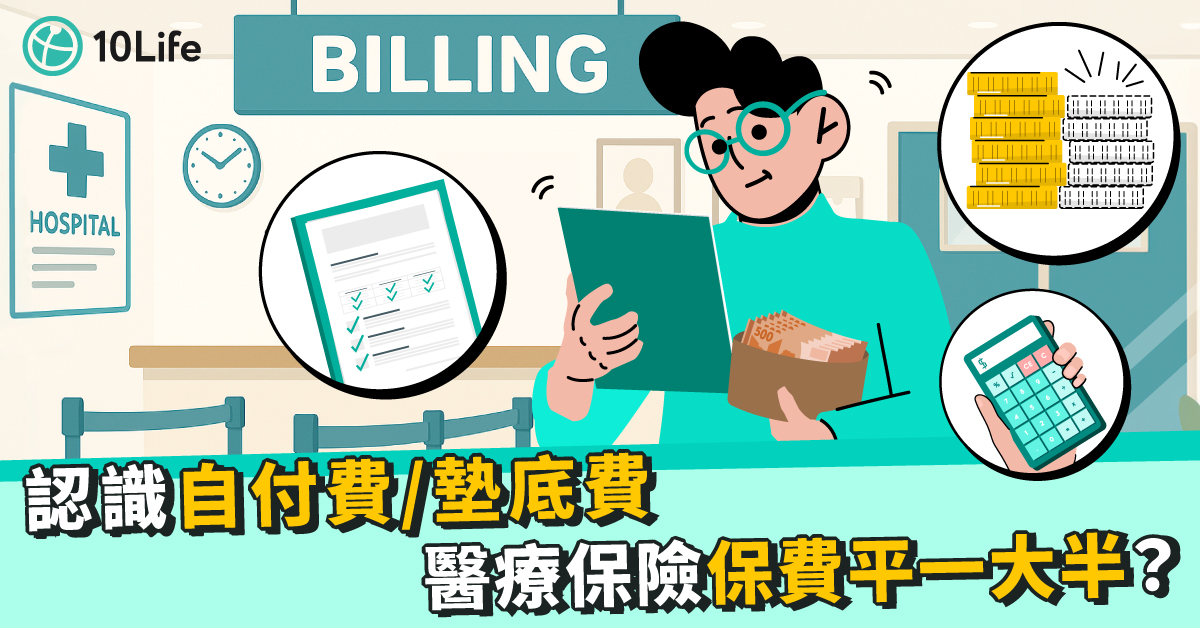
When buying insurance, you will usually encounter many technical terms. Deductible (also known as excess) is one of them, and you will often come across it when buying medical insurance or Voluntary Health Insurance (VHIS). Who, then, needs to purchase medical insurance with a deductible?
If an insured person purchases medical insurance with a deductible, they must first pay the deductible specified in the policy before making a claim with the insurance company. The insurance company will only reimburse medical expenses exceeding the deductible. The deductible is usually calculated per policy year. The advantage is that medical insurance with a deductible has lower premiums. The following two hypothetical examples provide a detailed explanation:
A 35-year-old insured person purchased a Voluntary Health Insurance Scheme plan with a HK$50,000 deductible in their early years. The plan is a “full reimbursement” plan, with an average annual premium of HK$4,291 over the next 10 years, which is 68% cheaper than the 10-year average premium of HK$13,390 for a plan with a HK$0 deductible.
The insured person was hospitalised due to an illness, incurring eligible medical expenses totalling HK$120,000. They therefore had to pay HK$50,000 “out of pocket”, while the insurer paid the remaining HK$70,000.
If the insured person is hospitalised again in the same policy year and incurs eligible medical expenses of HK$30,000, as the deductible for that year has already been paid and the medical insurance provides “full coverage”, the insurer will reimburse the full HK$30,000.
A 35-year-old insured person purchased a Voluntary Health Insurance Scheme policy in earlier years with a deductible of HK$20,000. The plan is a “full reimbursement” plan, with an average annual premium of HK$6,264 over the next 10 years.
The insured person was hospitalised due to an injury or illness, and the eligible medical expenses amounted to HK$18,000. The insured person was required to pay the full amount, and the insurance company would not provide any reimbursement. The remaining deductible for that policy year was HK$2,000.
The insured person was hospitalised again due to illness in a new policy year, with eligible medical expenses amounting to HK$10,000. However, as the deductible was reset to HK$20,000 at the beginning of the new policy year, the insured person was still required to pay the full HK$10,000.
Medical insurance policies offered by insurers include plans with deductibles, which can help prevent customers from abusing their medical cover. These plans provide protection when a customer suffers a serious illness or incurs substantial medical expenses, while also offering more affordable premiums. In fact, abuse of medical insurance is more common in relation to diagnostic procedures, such as colonoscopies. Having a deductible can therefore reduce unnecessary examinations requested by policyholders.
If the insured person has another medical insurance plan, such as group medical insurance provided by their employer (referred to as Plan A), with a medical reimbursement limit of HK$50,000, the policyholder may purchase another “full reimbursement” Voluntary Health Insurance Scheme plan with a deductible of HK$50,000 (referred to as Plan B).
For example, when an illness or injury occurs and the eligible medical expenses amount to HK$150,000, the insured person can first claim HK$50,000 from Plan A, use this claim amount to pay the HK$50,000 deductible under Plan B, and claim the remaining HK$100,000 from the insurer. Ultimately, they can obtain maximum protection at a lower premium.
In addition, some medical insurance plans on the market offer deductible reduction benefits. In simple terms, if the insured person has not made a claim during the previous policy year, the insurer will reduce the deductible for the following year. This reduces the incentive for policyholders to misuse medical insurance while providing greater protection when needed in the future.
Medical insurance offers different excess options, but general insurance policies such as Home protection insurance, pet insurance, TravelCare and motor insurance also include excesses for various coverage items. Taking Home protection insurance as an example, an excess applies to each item of household contents, with the original intention of preventing policyholders from abusing insurance claims.
Policyholders will often come across the term co-insurance. In fact, its principle is similar to that of an excess: the former means that, when an insured person makes a claim, the insured person pays a certain percentage of the eligible expenses and shares the risk, whereas the latter is presented as an actual monetary amount. Co-insurance can also reduce the incentive for insured persons to overuse medical services.
Finally, if prospective policyholders already have group medical insurance/company medical insurance and wish to enhance their cover for hospitalisation or surgical expenses, a VHIS plan with an excess may be helpful. You can use the Insurance Decoder to compare the cover and premiums.
| Points to note about self-payment/excesses |
| 1. Those with group medical insurance may choose medical insurance with an excess to reduce their financial burden |
| 2. The excess is reset once in every policy year |
| 3. An excess does not necessarily only apply to medical insurance; Home protection insurance and TravelCare are also common examples |
Note: This article was last updated on 17 September 2025.
This English version of this article has been generated by machine translation powered by AI. It is provided solely for reference purposes. In the event of any discrepancy or inconsistency between this translation and the original Chinese version, the Chinese version shall prevail.
Our team of professional content researchers focussing on insurance
Our team of professional content researchers focussing on insurance
10Life Product Comparison and 10Life Insurance Ratings are developed by 10Life Financial Limited, an authorised insurance broker company licensed with the Insurance Authority under License Number FB1526. 10Life Product Comparison and 10Life Insurance Ratings are developed for generic customer segments using mathematical calculations based on product information, facts and data, and are not influenced by any partnerships with or fees received from insurance companies. Any information on 10Life Platform ("10Life Information"), including but not limited to Product Comparison, Product Ratings, Blog Articles are intended for general education purpose and reference only. None of the 10Life Information is intended, nor should they be considered or relied upon, as regulated advice, insurance, financial, investment or professional advice, recommendation, approval, endorsement, invitation or solicitation in respect of any insurance, financial or investment products. 10Life Information does not take into account your individual needs. Reading 10Life Information should not be considered as conducting a suitability assessment, and is not sufficient to form the basis of any decisions to purchase any insurance products. You should rely on information authorised by insurance companies, carry out your own research and/or seek independent advice from licensed intermediaries before purchasing any insurance products or making any insurance decisions. While reasonable effort is used when collecting, validating and updating 10Life Information from various channels, none of 10Life Group and its subsidiaries, affiliates, agents, directors, officers and employees will be responsible for any liability, claim or loss arising from or associated with you using 10Life Information. No warranty, representation or guarantee is given by 10Life Group and its subsidiaries on the accuracy, completeness and timeliness of the information. If you have any questions on 10Life Product Comparison and 10Life Insurance Ratings, please email us at enquiries@10life.com




 Talk to 10Life on WeChat
