









10Life Financial Limited
Enquiries: enquiries@10life.com
Hotline: (852) 3705 1599
Address: 16/F Greatmany Centre, 109-115 Queen’s Road East, Wan Chai, Hong Kong






In the era of low interest rates, premium financing was once widely promoted, highlighting the leverage effect of using a relatively small amount of capital to secure a much larger sum insured. However, since 2022, the Federal Reserve has raised interest rates repeatedly, and the ultra-low interest-rate environment is now a thing of the past, bringing a sharp rise in borrowing costs. At the same time, returns on savings policies are often not fully guaranteed; if the non-guaranteed portion falls short of expectations, the room for profit from the interest-rate spread may shrink significantly. In the end, policyholders may not only fail to make a gain, but could also end up making a loss.
So how does this financial “double-edged sword” actually work? And what pitfalls should you know before taking out a policy? The following article will guide you from the basics to a deeper understanding, breaking down the mechanics of premium financing and its hidden risks one by one.
So-called premium financing means that when a policyholder takes out a single-premium savings insurance policy, they only need to prepare around 20% of the premium themselves, while the remaining amount is funded by a bank loan. This allows a larger policy to be purchased with less capital, using leverage to seek higher returns. For example, if a policyholder buys a savings insurance policy with a premium of US$1 million, they only need to pay about US$200,000 themselves, and borrow the remaining US$800,000 from a bank to pay the premium, with the policy serving as collateral. As long as the policy’s return exceeds the borrowing rate, the policyholder can profit from the interest rate spread.
However, premium financing remains a controversial practice among insurance products. The HKMA has received numerous complaints against banks relating to premium financing, including inadequate disclosure of risks, arranging financing without the customer’s knowledge, and failing to explain that the borrowing rate is variable, causing customers to suffer losses.
Loan interest rate > policy return rate = customers incur a loss
Policy financing was once all the rage. Rewind to 2021, when loan interest rates were as low as 1%, policyholders could take out savings insurance policies through premium financing and easily earn an interest spread. However, the Federal Reserve repeatedly raised interest rates between 2022 and 2023, with the US federal funds rate at one point rising to 5.25% to 5.5%. Although it began to ease rates gradually from 2024 onwards, as of May 2026 it was still higher than the ultra-low-rate environment seen during the pandemic.
In simple terms, premium financing works as follows: the loan interest rate is mostly linked to the Hong Kong Interbank Offered Rate (HIBOR), and HIBOR moves closely in line with US interest rates. At the time of writing, one-month HIBOR is around 3%, meaning borrowing costs are several times higher than in 2021. As a result, the interest spread on premium financing has narrowed significantly, so a high-interest-rate environment can seriously affect the returns of premium financing.
To explain how premium financing works using a savings insurance plan, let us assume the customer is a 40-year-old non-smoking woman, with a required premium of US$500,000. Through premium financing, the policyholder pledges the policy to a bank and can obtain a loan of US$382,500, meaning the actual premium paid is only about US$117,500, or around 23.5% of the total premium. According to the information, the insurer also offered the customer a US$40,000 premium rebate at the time.
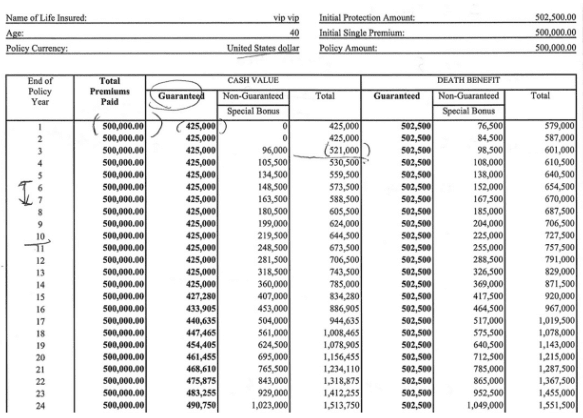
If the policyholder surrenders the policy in the expected breakeven year (i.e. the 3rd policy year), the projected cash value at that time will be USD521,000, which is USD21,000 higher than the original premium. Together with the premium refund of USD40,000, the total profit from this arrangement would be USD61,000. If interest expense is excluded, and based on the actual premium paid of only around USD117,500, the return would already be quite attractive.
Premium (A) | $500,000 | ||||
Premium financing amount | $382,500 | ||||
Expected profit before interest (B) | $61,000 | ||||
Average annual loan interest rate | 1% | 4% | 5.5% | 9% | 12% |
Interest payable over 3 years (C) | $11,475 | $45,900 | $63,112 | $103,275 | $137,700 |
Expected profit/loss after interest | Profit of $49,525 | Profit of $15,100 | Loss of $2,112 | Loss of $42,275 | Loss of $76,700 |
However, do not forget the interest expense! The table above sets out the actual profit and loss under different loan interest rates, and it can be seen that the higher the interest rate, the greater the policyholder’s loss.
The following are the risks of premium financing that should not be overlooked:
1. Dual pressure from interest rate hikes: paying interest and incurring losses, making surrender difficult to stem the losses
The core logic of premium financing is built on the premise that “policy returns > loan interest rate”. Once interest rates rise, this assumption no longer holds, and policyholders are caught between two pressures: on one hand, interest eats into returns; on the other, surrendering the policy to cut losses is constrained by its guaranteed cash value.
If the premium financing interest rate is as low as 1%, based on the above loan amount of US$382,500, the total interest payable over three years would be only about US$11,475. In an ideal dividend scenario, the policyholder could make a profit of US$49,525 after three years. However, if the average interest rate over three years rises to 5.5%, the interest expense would increase to US$63,112, and the policyholder would already begin to incur a loss (see Table 1).
Some may ask: seeing interest rates continue to rise and returns being eroded, would it be feasible to surrender the policy early to stop the losses? According to the benefit illustration in Figure 1, if the policyholder surrenders the policy in or before the second policy year, they would only receive the guaranteed cash value of US$425,000. After deducting the premiums paid and repaying the loan, the net loss would be US$75,000. In other words, even if the policyholder knows the outlook is unfavourable, they can only continue paying the interest and wait until the “break-even year” before surrendering the policy (without losing on premiums and interest) — leaving many policyholders caught between a rock and a hard place.
However, when interest rates rise to a certain level, surrendering early may actually result in a smaller loss. For example, if the expected loan interest rate over three years reaches 12%, the estimated loss caused by rising interest rates would be US$76,700 (see Table 1), which is already higher than the US$75,000 loss from early surrender — of two evils, the lesser must be chosen, and the policyholder would have no choice but to make a painful exit.
2. Can bonuses be fully realised at 100%?
The returns on savings policies are divided into two parts: “guaranteed” and “non-guaranteed”. The former is usually allocated more to bonds, while the latter involves a greater proportion of equity investment. Interest rate rises increase share market volatility, which may drag down non-guaranteed returns, meaning they may not be fully realised.
Using the above example, the US$21,000 non-guaranteed return over three years depends on the dividend fulfilment ratio. If the insurer’s dividend fulfilment ratio is 80%, the expected return would be discounted to US$16,800. Assuming a borrowing interest rate of 5.5%, the policyholder would incur a net loss of US$6,312 after three years (premium rebate US$40,000 + non-guaranteed return US$16,800 - interest expense US$63,112).
This shows that higher interest rates, combined with dividends that fall short of expectations, can both erode the returns from policy financing. The higher the proportion of non-guaranteed returns in a policy, the greater the impact. It is worth noting that the above calculation assumes the policyholder keeps the policy until year 3; if the policy is surrendered earlier, surrender charges will result in even greater losses. Before taking out a policy, consumers may first review the dividend fulfilment ratios of different insurers to understand how their non-guaranteed returns have been realised in the past.
3. There is a chance that the bank may call the loan, forcing the policyholder to exit at a loss
Premium financing means that the policyholder assigns the policy rights to a bank in exchange for a loan. The bank may suddenly call the loan for various reasons, including the policyholder’s failure to repay on time, deterioration in credit standing, a drop in the quality of the collateral, or tighter lending policies. If the insurer’s credit rating is downgraded, it faces a liquidity crisis, or even goes bankrupt (insurer insolvency is extremely rare in Hong Kong), or if the non-guaranteed returns fall short of expectations and the policy’s cash value declines, the bank will likewise reassess the loan amount and require additional collateral.
If the borrower is unable to cope, the bank may forcibly surrender the policy to offset the debt, and the surrender value will only be returned to the policyholder after deducting the outstanding amount. If it is still insufficient to repay the debt in full, the borrower must continue repaying the remaining liability. As such policies usually contain punitive terms, if premiums are not paid for the specified period and the policy lapses midway, the policyholder may lose everything.
4. Insurance advisers encourage mortgage refinancing, multiple gearing risks increase sharply
Some advisers encourage property owners to refinance their properties to unlock cash, then use the proceeds for premium financing, thereby re-mortgaging an originally debt-free home. For example, an owner may already have fully repaid their self-occupied property, yet be persuaded to re-mortgage it to raise HK$2 million, and then invest that amount into premium financing. The result is a double burden: the owner must service both the re-mortgage loan and the interest on the premium financing. If interest rates rise or returns fall short of expectations, losses are magnified on two fronts. In the worst-case scenario, the owner may lose the policy and still have to continue repaying the property loan, and may even face the risk of the bank repossessing the property.
5. Policy benefits have been assigned to the bank; the policyholder’s rights are restricted
After a policy is assigned to a bank as collateral, the bank may exercise the policyholder’s rights on their behalf. If the insured passes away while the loan remains outstanding, the death benefit must first be used to repay the loan, with any remaining balance paid to the beneficiary. In addition, the policyholder may only exercise rights such as the cooling-off period and changing the beneficiary with the bank’s consent.
Premium financing: a double-edged sword behind high returns
Premium financing is a legitimate financial planning tool; the key issue is whether it matches the right investor. It is more suitable for high-net-worth individuals and those with ample reserve funds — such clients are usually able to secure lower loan interest rates from banks (widening the interest spread), have sufficient idle capital to cope with sudden rate hikes or a call on the loan, and can hold the policy for the long term to ride out economic cycles.
Conversely, if any of the following apply to you, this tool is absolutely unsuitable:
Other real-life victim cases:
【Insurance Clinic】Turning term insurance into borrowing money to buy savings insurance; a bank suddenly called in the loan, exposing a sales trap
【Insurance Clinic: Premium Financing】A 65-year-old retired grandmother fell into the “insurance death trap” and was left with a huge HK$5 million debt!
Premium financing involves leverage and interest rate spread risk, and in the past, it has also given rise to numerous sales disputes in a low-interest-rate environment. After a joint inspection, the Insurance Authority and the Hong Kong Monetary Authority pointed out that the industry still has room for improvement in areas such as affordability assessment, asset verification, risk disclosure, sales practices, and explanations of the cooling-off period.
In response to the above issues, the authorities introduced new regulations from 1 January 2023, requiring intermediaries and banks to strictly follow the procedures below when customers take out products involving premium financing:
In simple terms, if you are considering premium financing, do not blindly believe claims that it is a “sure win”. Before taking out a policy, you should carefully review the stress test results in the statement and ensure that, even in a high-interest-rate environment, you still have sufficient cash flow to meet interest expenses, so as to avoid being forced to miss premium payments or surrender the policy early. If you would like to compare the guaranteed and non-guaranteed returns of different savings insurance plans, you may use the 10Life savings insurance comparison tool, or contact our licensed advisory team via WhatsApp for a free consultation.
In addition, if you suspect that you may have experienced improper insurance sales practices, you are also welcome to contact 10Life. We will be pleased to help you understand your rights and the feasible follow-up options.
Notes:
1. The premium information and calculations above are for illustrative purposes only, based on a real policy case from September 2022, and do not include the premium levy charged by the Insurance Authority. Actual premiums and returns are subject to the individual policy.
2. Last updated on: 28 May 2026.
This English version of this article has been generated by machine translation powered by AI. It is provided solely for reference purposes. In the event of any discrepancy or inconsistency between this translation and the original Chinese version, the Chinese version shall prevail.
I’m delighted to be part of 10Life in building a one stop insurance platform.
10Life Product Comparison and 10Life Insurance Ratings are developed by 10Life Financial Limited, an authorised insurance broker company licensed with the Insurance Authority under License Number FB1526. 10Life Product Comparison and 10Life Insurance Ratings are developed for generic customer segments using mathematical calculations based on product information, facts and data, and are not influenced by any partnerships with or fees received from insurance companies. Any information on 10Life Platform ("10Life Information"), including but not limited to Product Comparison, Product Ratings, Blog Articles are intended for general education purpose and reference only. None of the 10Life Information is intended, nor should they be considered or relied upon, as regulated advice, insurance, financial, investment or professional advice, recommendation, approval, endorsement, invitation or solicitation in respect of any insurance, financial or investment products. 10Life Information does not take into account your individual needs. Reading 10Life Information should not be considered as conducting a suitability assessment, and is not sufficient to form the basis of any decisions to purchase any insurance products. You should rely on information authorised by insurance companies, carry out your own research and/or seek independent advice from licensed intermediaries before purchasing any insurance products or making any insurance decisions. While reasonable effort is used when collecting, validating and updating 10Life Information from various channels, none of 10Life Group and its subsidiaries, affiliates, agents, directors, officers and employees will be responsible for any liability, claim or loss arising from or associated with you using 10Life Information. No warranty, representation or guarantee is given by 10Life Group and its subsidiaries on the accuracy, completeness and timeliness of the information. If you have any questions on 10Life Product Comparison and 10Life Insurance Ratings, please email us at enquiries@10life.com




 Talk to 10Life on WeChat
